

Artykuł: Best Washable Rugs for European Kitchens | Runners & Low-Profile Picks | Rug Editorial
Best Washable Rugs for European Kitchens | Runners & Low-Profile Picks | Rug Editorial
Best Washable Rugs for European Kitchens
The best washable rug for a European kitchen is a low-profile runner, sized to the galley or the in-front-of-sink zone, with built-in non-slip backing and small enough to drop into the washing machine you already own. Every other consideration — palette, pattern, style — sits comfortably downstream of those four practical choices.
The kitchen is the room that punishes a poorly chosen rug fastest. Splashes from the sink, drips from the fridge door, crumbs from the counter, oil from a frying pan, muddy soles back from the bins — all of it lands within a metre of where you stand to cook. A traditional rug under those conditions spends its life either being protected from the room or quietly absorbing it. A washable rug, sized and specified correctly, just does its job, comes out, goes through a cycle, and goes back down. This is a buying guide to the best washable rugs for European kitchens: how to size a runner to your floor plan, pick a profile that lives under cabinet and oven doors, and choose a palette that takes a year of cooking in stride.
What matters most when buying a kitchen rug
Four decisions do most of the work. Get these right and the design choices afterward are the enjoyable part.
1. Shape and size relative to the kitchen footprint
European kitchens are rarely square rooms with one open patch of floor. They are galleys, L-shapes, U-shapes, peninsulas, and narrow corridors with a sink on one side and a hob on the other. That geometry means the kitchen is almost always a runner room, not a rectangular-rug room.
The most useful sizes in a kitchen are the two runner formats:
- 75 × 215 cm — the right size for a single-zone runner: in front of the sink in a galley kitchen, along the working stretch of an L-shape, or under the long side of a kitchen island that runs around two metres.
- 75 × 305 cm — the right size for a longer galley or a corridor kitchen where the runner needs to carry the full length of the working aisle from sink to oven, or for a generous island that runs three metres or more.
The 90 × 150 cm small rectangular size has a place too, especially as a single working mat directly in front of the sink in a compact U-shaped kitchen where a runner would overshoot the cabinet line at one end. It is the workhorse size for a one-spot kitchen rug.
The rule a runner needs to obey: it should sit centred between the cabinet runs on either side, with roughly equal floor showing on the long edges, and stop clear of door swings at both ends. A runner that touches the cabinet kickboards on both sides looks like a too-large doormat; one that floats in the middle of a wide floor looks marooned. If the working aisle is wider than about 120 cm, consider stepping up to the longer runner rather than the wider rug — length is almost always more useful than width in a kitchen.
Our size guide covers the measuring step by step, and the companion piece on choosing the right rug size walks through the runner-versus-mat decision in more detail. A small but useful test: stand at the sink, take one normal step backward, and then a second. If both feet still land where the runner will sit, the runner is doing the job it was bought for.
2. Profile (pile thickness)
The kitchen is the room where pile matters most after the bedroom, and for a similar reason: things move against the floor. Cabinet doors swing outward, oven doors drop down, dishwasher doors hinge open, fridge doors clear the floor with very little margin. A high-pile rug in front of any of those is a daily problem.
Rug Editorial offers two pile profiles, and for kitchens the choice is straightforward. The flat weave collection sits at 2 mm — low-profile, architectural, designed for rooms where door and appliance clearance is tight. It is the natural pile for a kitchen. The faux wool collection sits at 5 mm — a touch softer underfoot, and a sensible choice for the rare kitchen with generous appliance clearance and a real desire for a more cushioned step in front of the sink. But across most European kitchens, where dishwasher doors clear the floor by a few millimetres and oven doors drop to within a centimetre of it, the 2 mm flat weave is the safer and more practical choice. It also folds more compactly for the wash, dries faster, and reads quieter under the visual noise of cabinetry, tile, and the things on the counter.
The honest summary: in a kitchen, start with the flat weave. Pivot to faux wool only if you have measured clearances and a softer step matters more to you than easy maintenance.
3. Washability and your washing machine
A kitchen rug is the rug in the home that earns its washability the most. It is also the rug most likely to need to fit a smaller European washing machine — kitchens and washing machines are often in the same compact apartment.
From Rug Editorial's washing-machine guide, the kitchen-relevant size-to-drum match is:
- 6 kg or larger: the 90 × 150 cm rug fits. This is the size that matches the largest installed base of European apartment washing machines.
- 10 kg or larger: the 75 × 215 cm and 75 × 305 cm runners fit, alongside the 90 × 150.
In a kitchen, that's all the maths you really need. A 6 kg machine in a city flat will take the 90 × 150 working mat without issue; a 10 kg or larger family machine takes the runners as well. If your machine is at the smaller end and you want a runner, the practical workaround is the same as in any other room: spot clean it between full washes, then take it to a commercial laundromat for the occasional deep wash. The point is to know which trade-off you are buying before you commit, not to find out a fortnight later. The washing machine guide covers the full table, and the step-by-step on washing a large rug in a European washing machine covers cycle settings and drying posture if you push toward the longer runner end.
4. Backing and how the rug stays put
The kitchen floor is the rug in the home most likely to be walked on with wet, slippery, or oil-flecked soles, and most likely to be stepped on quickly when something needs attention on the hob. A rug that slides under that load is dangerous. A rug that stays put is the difference between a useful surface and a hazard.
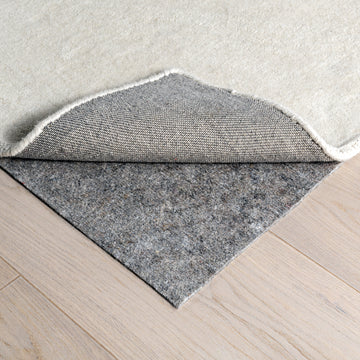
Every Rug Editorial rug has a built-in non-slip backing, so no separate rug pad is required. That matters in a kitchen specifically because a separate rug pad in front of a sink is the part of the kitchen that gets wettest, hardest to clean, and slowest to dry — eliminating that layer simplifies the maintenance routine. If you want extra cushioning on a hard tile or concrete kitchen floor — standing in front of the hob for an hour adds up — there is an optional 4 mm felt rug pad sold as an add-on, marketed for extra cushioning and floor protection. It is a comfort upgrade, not a structural requirement.
Best styles, materials and features for kitchens
Once the runner is sized, the pile chosen and the wash logistics settled, the kitchen rug becomes a design decision. A few patterns worth knowing about.
Palettes that take cooking in stride
Kitchens reward palettes that work with daily life rather than against it. Pure white reads beautiful in a catalogue and exhausting in practice — every crumb, every drip, every smudge announces itself within a week. Pure black is the same problem in reverse: dust and lint show as snow. The palettes that hold up are mid-tones — sand, mushroom, soft taupe, warm grey, faded terracotta, washed indigo, dusty olive — and multi-tonal weaves that hide the inevitable life of the room between washes.
Pattern earns its place in a kitchen. A low-contrast Persian medallion, a softened geometric, a quietly faded floral, a Moroccan diamond in muted tones — these all read as texture from a normal viewing distance and forgive day-to-day life far better than a flat single colour. Save the higher-contrast pattern for the entryway or living room, and lean a half-step calmer in the kitchen, where the cabinetry, the tile and the things on the counter are already doing visual work.
There is a wide range of colours and multicolour combinations across the catalogue, and the kitchen is the room to browse with that bias in mind: a rug that picks up one tone from your countertop or your cabinet door fronts will read as a deliberate composition rather than a decorative accident. Our editorial on spring 2026 European rug trends for modern homes covers the warmer earth-tones and softer faded patterns we are watching this year, and most of those translate cleanly into the kitchen.
Style families that suit kitchens
A handful of Rug Editorial's style categories tend to work especially well in a European kitchen:
- Persian, Traditional and Transitional — the muted, layered versions read warm and grown-up under cabinetry and tile, and forgive daily life better than almost anything else. A faded Persian runner in front of a sink is the classic European-kitchen choice for a reason.
- Geometric and Mid-Century Modern — clean lines that work hard in a fitted kitchen with a strong cabinet language. Pick the lower-contrast versions; high-contrast graphics fight cabinet hardware and tile.
- Bohemian, Global and Moroccan — relaxed, textural and forgiving; the easy choice for a kitchen with timber counters, open shelving and a more domestic, lived-in feel.
- Farmhouse, Rustic and Floral — softer, warmer choices for a country-style kitchen, a kitchen that opens onto a dining table, or a space where the rug is meant to feel a touch more decorative than purely architectural.
- Scandinavian and Modern & Contemporary — pared-back and quiet, ideal for compact urban kitchens where the rug should recede and let the room breathe.
You will find every one of these in the full washable rug collection — filter for the size you have settled on first, then narrow by style and colour.
Features that earn their keep in a kitchen
Three structural features matter more in a kitchen than people expect:
- Built-in non-slip backing. A kitchen rug that stays put is a kitchen rug you can step onto carrying a hot pan without thinking about it. Every Rug Editorial rug has the backing built in.
- OEKO-TEX certification. Every Rug Editorial rug is OEKO-TEX certified, which means the textile has been independently tested against a defined list of regulated and potentially harmful substances. That is a sensible baseline anywhere food is prepared and where pets and children spend time on the floor — a tested textile underfoot adds up. Our editorial on what OEKO-TEX certification means for a washable rug covers what the certification actually does, and just as usefully, what it deliberately does not.
- Underfloor-heating compatibility. Rug Editorial rugs are fully compatible with underfloor heating and are designed to let heat pass through efficiently. That matters in modern European kitchens with heated tile or engineered timber — a rug that blocks the heat is a rug that fights the room.
Two practical notes on what the rug is not engineered for, kept honest:
- Stain and spill behaviour. Washable means designed to be machine washed; it does not mean stain-proof or waterproof. Blot a spill immediately with a clean sponge or cloth, spot clean with mild detergent as needed, and put the rug through a full wash when it stops feeling fresh. The maintenance logic is the appeal of the category; the absence of an unrealistic spill-proof promise is part of being honest about what a kitchen rug actually does.
- Indoor use. Rug Editorial rugs are designed for indoor rooms — including kitchens. They are not engineered for outdoor or covered-patio use, and you should not place one outside a back door or in an open-sided garden room.
Common mistakes to avoid
A handful of patterns worth deliberately avoiding when choosing a kitchen rug.
Buying a square or rectangular rug for a runner-shaped floor. A 90 × 150 cm rug placed in a galley where a 75 × 305 runner would have fit reads as a small island in a long room. Measure the working aisle first, then shop the shape that matches it.
Ignoring appliance and cabinet clearance. A 5 mm pile rug in front of a dishwasher whose door clears the floor by 6 mm is a daily catch. Either pick the 2 mm flat weave or position the rug so it stops clear of the appliance door's swing.
Choosing a rug that doesn't fit your washing machine. The whole point of a washable kitchen rug is the maintenance routine. If your machine is 6 or 7 kg, the 90 × 150 is the natural choice; the runners ask for a 10 kg machine or a willingness to use a commercial laundromat occasionally. Decide the trade-off before you buy.
Choosing pure white or pure black. Both look stunning in a catalogue and unforgiving in a real kitchen. Pick a mid-tone or a multi-tonal weave and the rug will read clean far longer between washes.
Matching the rug too literally to the cabinetry. A rug in the exact tone of the cabinet doors reads flat and staged. A rug that picks up one tone from a worktop, a backsplash, or a stool seat — and adds its own warmth — reads as styled.
Treating the rug as fragile. A washable kitchen rug is designed to be washed. Cold water, delicate cycle, mild detergent, no bleach, then air dry flat or hang to dry — that is the entire routine. Run it when the rug stops feeling fresh and the room will tell you when.
Recommended Rug Editorial collections for the kitchen
If you are starting from the kitchen brief rather than from a full browse, three useful entry points:
- The flat weave collection — the 2 mm low-profile line and the natural home for kitchen runners. Easy to clear under cabinet and appliance doors, fast to wash, fast to dry.
- The faux wool collection — the 5 mm slightly plusher line. The right choice when appliance clearance is generous and you want a softer surface in front of the sink or hob.
- The full washable rug collection — filterable by size, colour and style. Start here once you know your runner length, and want to browse pattern and palette freely.
Free shipping is included on every order across the European countries Rug Editorial delivers to — orders ship from a Romanian warehouse via FedEx, and the website lists the per-country delivery windows — and a 30-day return window with a prepaid FedEx return label means you can audition a rug in your own kitchen light before committing. Kitchen light, in particular, is unforgiving to catalogue photography: warm bulbs, mixed surfaces, and a lot of incidental shine. Auditioning at home is more useful than any product shot.
If you have already chosen a dining-room rug, a living-room rug or a bedroom rug, let the kitchen rug pick up one tone from the rooms next to it rather than starting an entirely new palette. In an open-plan apartment where the kitchen reads straight into the living area, that one-tone continuity is the difference between a finished home and a series of separate rooms.
Frequently asked questions
What size washable rug do I need for a galley kitchen?
For a working aisle around two metres long, a 75 × 215 cm runner placed in front of the sink and the main working zone is the most reliable answer. For a longer galley or a corridor kitchen where the runner needs to carry the full length from sink to oven, step up to 75 × 305 cm. If the kitchen is a compact U-shape with one busy spot in front of the sink, a 90 × 150 cm rectangular rug as a working mat is often the cleaner choice.
Will the runner fit under my dishwasher and oven doors?
The 2 mm flat weave line is designed to clear standard appliance doors with no adjustment, which is why it is the natural pile for a kitchen. The 5 mm faux wool line typically clears most appliance doors, but in kitchens where the dishwasher or oven door drops within a few millimetres of the floor, the flat weave is the safer choice. The cleanest test is to measure the gap between the lowest point of the appliance door and the floor before you choose.
Can I use a washable rug over underfloor heating in the kitchen?
Yes. Rug Editorial rugs are fully compatible with underfloor heating and are designed to let heat pass through efficiently. In a kitchen with heated tile or engineered timber, the 2 mm flat weave is the easier all-rounder because the thinner profile interferes less with heat transfer.
How often should I wash a kitchen rug?
The brand does not specify a frequency, and kitchen usage varies a lot — a holiday-let kitchen and a primary kitchen feeding a young family will see very different cycles. As a practical rule, vacuum it without a beater bar to keep crumbs from working into the weave, blot any spill immediately with a clean sponge or cloth, spot clean stains with mild detergent as needed, and run a full machine wash whenever the rug stops feeling fresh. The companion guide on how to clean a washable rug covers the day-to-day routine and the full-wash logic in more detail.
Is the optional rug pad worth it under a kitchen rug?
It is a comfort upgrade rather than a requirement. Built-in non-slip backing keeps a Rug Editorial rug in place without it. The optional 4 mm felt pad is marketed for extra cushioning and floor protection — useful on a hard tile, stone or concrete kitchen floor where you stand for long stretches at the sink or hob, less essential on engineered timber that already has some give underfoot.
Is the rug safe around pets and small children in the kitchen?
Every Rug Editorial rug is OEKO-TEX certified, and the brand describes its materials as safe for both humans and animals. In a kitchen where a dog tends to install itself between the fridge and the dishwasher, or a child eats yoghurt on the floor, a tested textile underfoot is a sensible baseline. Pair it with the practical choices that also matter — a low-profile rug that stays put, a mid-tone palette that hides daily life between washes, and a size that fits the washing machine you actually own.
Closing note
A kitchen rug is the surface you cook on, in a real sense — the floor your feet land on when the timer goes off, the surface that catches the drip from the kettle, the runner that quietly defines the working aisle of the room. Choose one sized to the floor plan you actually have, low-profile enough to live under cabinet and appliance doors, and made to be washed in the machine you actually own. Lean toward mid-tones and multi-tonal weaves, let pattern do the work of hiding daily life, and treat the rug as the workhorse it is rather than a decorative object to be protected.
When you are ready to choose, the flat weave collection is the natural starting point for almost every European kitchen; the faux wool collection is the right pivot when appliance clearance is generous and you want a softer step. Either way, match the runner to the aisle first, then let pattern and colour be the enjoyable part.