

Washable Rugs and Underfloor Heating | A Practical European Guide | Rug Editorial
Washable Rugs and Underfloor Heating: What Actually Works
A washable rug works perfectly well over underfloor heating. Rug Editorial rugs are fully compatible with underfloor heating and are designed to let heat pass through efficiently — the choice that actually matters is profile, because a low, evenly laid rug lets warmth move into the room far more readily than a thick or poorly positioned one.
Underfloor heating has become the default in a large share of new-build and renovated European homes — even, space-saving, and genuinely pleasant to stand on in a Bucharest or Berlin winter. But it also creates a hesitation that stops people from buying the rug their room actually needs: the worry that a rug will trap the heat, waste the system, or be harmed by the warmth from below. None of that has to be true. With the right rug and a sensible setup, a washable rug and a heated floor are a good pairing — you keep the warmth of the system and gain the comfort, definition, and quiet of a textile underfoot.
This is a problem-solving guide to doing it well: how heat behaves under a rug, the setup, washing, the care mistakes to avoid, and when a smaller or lower-profile rug is the smarter call.
How heat behaves under a rug
Start with the physics, briefly. Underfloor heating warms a room by turning the whole floor into a gentle, low-temperature radiating surface — designed to run warm, not hot, spread across a large area rather than concentrated like a wall radiator. Anything you place on that floor becomes part of the path the warmth travels into the room.
A rug is therefore a layer — not a problem, just the fact that governs the choice. A thin, low-profile rug in full, flat contact with the floor is a thin layer, and warmth moves through it readily. A thick rug, a rug stacked on a separate insulating pad, or a rug lying with air pockets and ruck lines underneath it is a thicker and less even layer, and the room warms more slowly and less predictably as a result.
Rug Editorial's guidance — that the rugs are fully compatible with underfloor heating and allow heat to pass through efficiently — comes with a practical footnote: compatibility is built into the rug, but efficiency is something you set up, by laying the rug flat, in full contact, with nothing extra underneath it.
Rug Editorial makes two lines, both compatible with underfloor heating: the flat weave collection at a 2 mm profile and the faux wool collection at 5 mm. These are the only two constructions in the catalogue, so there is no deep-pile or shaggy option to worry about. The 2 mm flat weave is simply the more efficient one, and for most heated rooms it is the line to reach for first.
Step by step: setting up a washable rug over underfloor heating
1. Choose a low-profile rug
The most important decision happens before the rug arrives. Over underfloor heating, profile beats every other variable. The 2 mm flat weave collection is the natural first choice — low enough that it behaves almost like a patterned extension of the floor, and quick to warm through. The 5 mm faux wool collection is still compatible and a sensible choice if you want a slightly softer surface underfoot, particularly in a bedroom; it is just a marginally thicker layer. If you want the heating to feel as responsive as possible, start with flat weave; if comfort outranks responsiveness, faux wool is fine.
2. Skip the separate rug pad
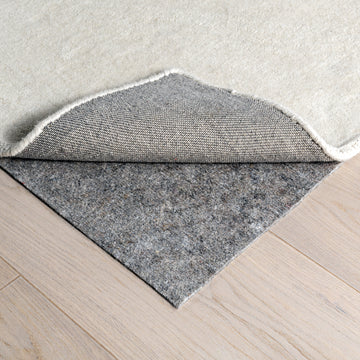
Many washable-rug systems on the market rely on a separate non-slip pad or underlay beneath the rug. Rug Editorial rugs do not: every rug has built-in non-slip backing, so no separate rug pad is required. Over underfloor heating, that is more than a convenience — it means there is no extra felt or rubber layer sitting between the warm screed and the room. Rug Editorial does sell an optional 4 mm felt rug pad, marketed for extra cushioning and floor protection, and it earns its place in plenty of homes with hard, cold floors. But over underfloor heating most people simply leave it out and rely on the rug's own backing, precisely because the goal here is fewer layers, not more.
3. Lay the rug flat and in full contact
Heat moves most evenly where the rug touches the floor along its whole footprint. After unrolling, take a few minutes to settle the rug: smooth out ruck lines, press the corners down, and check for trapped air pockets or folded edges. A rug in full, flat contact warms evenly; one with a wave through the middle creates a cooler ridge and a warmer trough. New rugs often arrive with shipping creases — that is normal, and how to flatten a washable rug after unboxing covers the full method. Gentle warmth from the heated floor actually helps a new rug settle faster, so underfloor heating works in your favour here.
4. Run the heating as you normally would
There is no need to treat the floor differently because a rug is on it — no special low setting, and no need to push the temperature higher to compensate. Bring the system up to temperature the way you usually would and let it find its rhythm; a low-profile rug does not change how the system behaves. If you have zone controls, the room with the rug can stay on the same schedule as the rest of the home.
5. Give the room a day to settle
When you first add a rug to a heated room, give it a day before you judge how the room feels. The floor, the rug, and the air reach a steady state together. A room that feels marginally slower to warm on the first morning is usually indistinguishable from a bare-floor room within a day, especially with a 2 mm flat weave.
European washing-machine size considerations
A rug over underfloor heating is still a washable rug, and at some point it goes in the machine. The heated floor changes nothing about the wash itself — but it is worth planning the wash before you buy, because the size that suits your room also has to fit your washing machine. Rug Editorial's verified size-to-drum table maps cleanly onto the machines people actually own: apartment machines are commonly 6 to 8 kg, family machines tend to be 10 or 12 kg, and 14 kg drums sit at the larger end of the market.
| Rug size (cm) | Minimum European washing-machine drum |
|---|---|
| 90 × 150 | 6+ kg |
| 75 × 215 | 10+ kg |
| 75 × 305 | 10+ kg |
| 150 × 215 | 10+ kg |
| 185 × 275 | 12+ kg |
| 245 × 305 | 14+ kg |
| 245 × 330 | 14+ kg |
If the rug that suits your heated room is larger than your machine can take, that is not a dead end. As Rug Editorial's washing machine guide explains, you can spot-clean the rug day to day and take it to a commercial laundromat for the occasional full wash. How to wash a large rug in a European washing machine is the full step-by-step for the bigger sizes — folding logic, cycle settings, and drum capacity. The wash itself is always the same gentle routine: a delicate cycle, cold water, mild detergent, and no bleach.
Drying and care mistakes to avoid
A few patterns are worth avoiding specifically when a washable rug lives over underfloor heating.
Drying a washed rug on the heated floor itself. When the rug comes out of the machine, the instinct in a home with underfloor heating is to lay it straight back down on the warm floor to dry. Resist it. A heavy, wet rug pressed onto the floor dries slowly and unevenly from one side only, and it traps moisture against the screed. The verified care guidance is to air dry the rug flat or hang it to dry — on a drying rack, across two parallel chairs, or over a wide rail — with air able to reach both faces. Put the rug back on the heated floor only once it is completely dry.
Stacking a thick pad under the rug. Covered above, but it is the most common heat-related mistake: an extra insulating layer is the thing most likely to make a heated room feel sluggish. The built-in non-slip backing is all the rug needs to stay in place.
Choosing a deep-pile rug for the look. Rug Editorial only makes 2 mm and 5 mm constructions, so this is not a risk within the catalogue — but if you are comparing rugs across the wider market, a thick shag or high-pile rug is the wrong tool for a heated room. Lower profile is the rule.
Pushing the floor temperature up to force heat through the rug. Running the system hotter to compensate for a rug is unnecessary with a low-profile washable rug, and it works against the even, gentle nature of underfloor heating. Set the room to the temperature you want and let the system hold it.
Vacuuming with a beater bar. Unrelated to the heating, but worth including: vacuum the rug without a beater bar to keep the surface and backing in good condition. How to clean a washable rug covers the full day-to-day routine — spot-cleaning, vacuuming, and the wash cycle.
When to choose a lower-profile or smaller rug
For most heated rooms the decision is straightforward — choose the 2 mm flat weave and lay it well. But there are a few cases where leaning even further toward low-profile or smaller is the right call.
A room where the heating is the only source of warmth. If underfloor heating is the sole heat source, you want the rug to interfere as little as possible — the flat weave at 2 mm, and a size that leaves a reasonable margin of exposed floor around the rug rather than covering it almost wall to wall.
A heated kitchen or hallway. These rooms suit runners and smaller rectangles anyway, and the smaller sizes — the 90 × 150 cm rug, or the 75 × 215 cm and 75 × 305 cm runners — are both low-profile-friendly and easy to wash in a typical European machine. A smaller rug over underfloor heating is the easiest version of this whole exercise.
A bedroom where you still want softness. The faux wool 5 mm line is the compromise here — slightly softer underfoot for stepping out of bed, still compatible with underfloor heating. If the bedroom is a place where comfort outranks heating responsiveness, faux wool is a reasonable choice. Our guide to the best washable rugs for European bedrooms covers sizing the rug to the bed; the same logic applies over a heated floor, just with a bias toward the lower profile.
To size any of these correctly, the size guide and the companion piece on choosing the right rug size walk through measuring the room and the furniture step by step.
Related guides and collections
A few useful next steps depending on what brought you here:
- Choosing a rug for a heated living room? Best washable rugs for living rooms covers sizing the rug to the seating group — read it alongside the low-profile guidance above.
- Buying for a heated bedroom? Best washable rugs for European bedrooms covers under-bed sizing and door clearance, both of which favour a low profile.
- Planning the wash? The washing machine guide maps every rug size to a minimum drum capacity, and how to wash a large rug in a European washing machine is the full walkthrough for the bigger sizes.
- Ready to browse? The full washable rug collection is filterable by size, colour, and style. For a heated room, start with the flat weave collection and keep the faux wool collection in mind for bedrooms.
FAQs
Can you put a washable rug on underfloor heating?
Yes. Rug Editorial rugs are fully compatible with underfloor heating and are designed to let heat pass through efficiently. The practical key is profile: a low, evenly laid rug — the 2 mm flat weave is ideal — lets warmth move into the room readily, while a thick rug or an extra insulating pad slows it down.
Will a rug stop underfloor heating from working?
A low-profile washable rug laid flat does not stop the heating from working — it sits in the path of the warmth as a thin layer that heat passes through. What slows a heated room down is thickness and extra layers: a deep-pile rug, a separate felt pad underneath, or a rug rucked up with air pockets. Choose a 2 mm flat weave, skip the pad, and lay it flat.
Flat weave or faux wool over underfloor heating?
Both are compatible. The 2 mm flat weave is the more efficient choice and the one to reach for in living rooms, kitchens, and hallways where you want the heating to feel responsive. The 5 mm faux wool is still fine — a marginally thicker layer — and a reasonable pick for a bedroom where a slightly softer surface underfoot matters more than maximum heat responsiveness.
Do I need a rug pad over underfloor heating?
No. Every Rug Editorial rug has built-in non-slip backing, so no separate rug pad is required. That is genuinely useful over a heated floor, because a separate pad would add an extra layer between the screed and the room. The optional 4 mm felt rug pad Rug Editorial sells is for cushioning and floor protection on hard floors — useful in some homes, but most people heating from below leave it out.
Can I machine wash a rug that lives over underfloor heating?
Yes — underfloor heating changes nothing about the wash. Use a delicate cycle, cold water, mild detergent, and no bleach, as long as the rug fits your machine's drum; the size-to-drum table above shows the minimum capacity for each size. The one thing to get right is drying: air dry the rug flat or hang it to dry, and only return it to the heated floor once it is completely dry — do not lay a wet rug on the warm floor to speed things along.
A washable rug and underfloor heating are not a compromise — they are a good match, as long as the rug is low, flat, and free of extra layers underneath. Pick the profile that suits the room, lay it well, run the heating as normal, and wash it gently when it needs it. Browse the full washable rug collection when you are ready, and start with the flat weave line for any room heated from below.